On this page
What is EVAR?
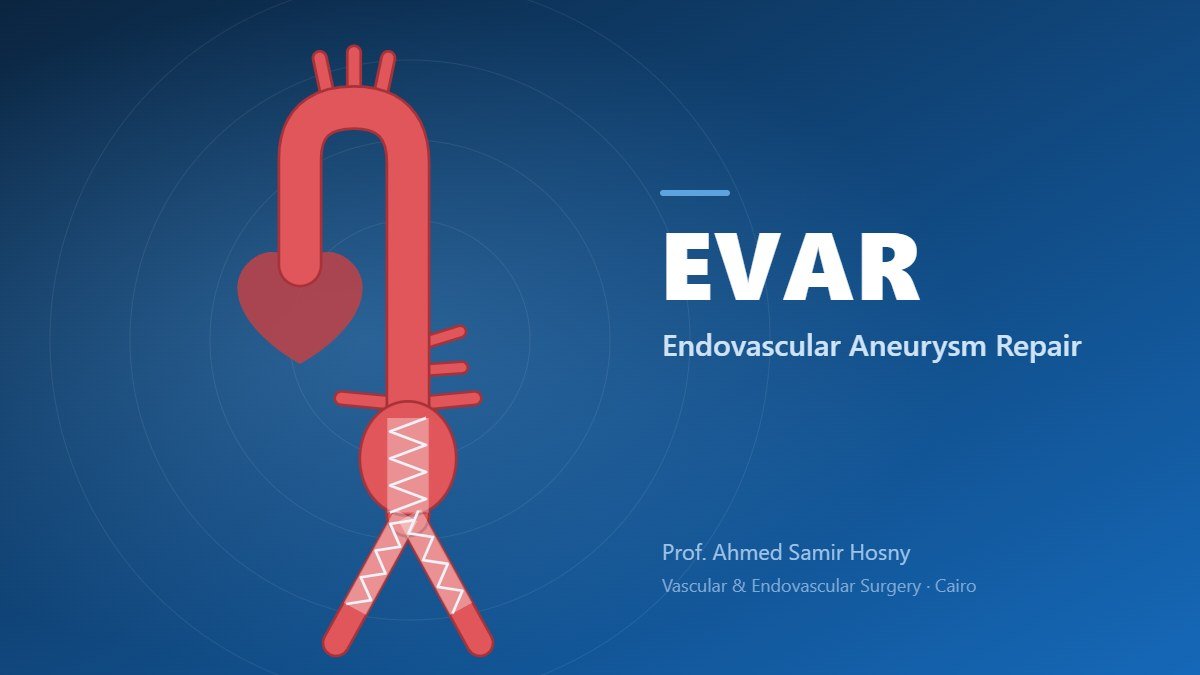
EVAR stands for Endovascular Aneurysm Repair. A covered stent-graft — a tube of durable medical fabric supported by a metal frame — is placed inside the aorta across the aneurysm. It seals in the healthy aorta above the aneurysm and in the iliac arteries below it, so blood flows through the graft instead of against the weak aneurysm wall. Pressure on the sac falls and the risk of rupture is removed.
Who is a candidate for EVAR?
Repair is usually recommended when the aneurysm reaches about 5.5 cm in men and 5.0 cm in women, grows quickly (more than 1 cm per year), or causes symptoms such as abdominal or back pain. Suitability for EVAR depends on:
- The aneurysm “neck”: length, diameter and angle of the healthy aorta below the kidney arteries.
- The diameter of the iliac and femoral arteries the device must pass through.
- Overall heart, lung and kidney health.
- Age, expectations and the ability to attend regular follow-up scans.
All of this is assessed precisely on a CT angiogram of the aorta, which is also used to size the right device for each patient.
How is the procedure performed?
- It is done in an operating room equipped with high-quality X-ray imaging, under spinal or general anaesthesia, and sometimes local anaesthesia with sedation.
- A wire and catheter are introduced through the femoral artery, most often by needle puncture (percutaneous) or a small incision.
- The folded stent-graft is guided under X-ray to its position, then deployed against the aortic wall.
- The limbs are extended into the iliac arteries and a final angiogram confirms a complete seal with no leak.
The procedure usually takes 1.5 to 3 hours depending on complexity.
Advantages over open surgery
- No large abdominal incision and less pain afterwards.
- Shorter hospital stay — typically 1 to 3 days.
- Faster return to normal life, usually within about two weeks.
- Lower early complication and mortality rates, especially in older patients and those with heart or lung disease.
Recovery and follow-up
Most patients walk the next day. A key feature of EVAR is the need for lifelong imaging follow-up (CT or duplex ultrasound) to confirm that the graft remains secure and that there is no endoleak, migration or growth of the aneurysm sac. Most of these issues are detected early and can usually be treated with a catheter procedure.
Frequently asked questions
Is EVAR dangerous?
It is one of the safest ways to treat an abdominal aortic aneurysm, with lower early risk than open surgery, but it remains a major procedure that needs careful assessment and an experienced team.
Is a stent-graft suitable for everyone?
No. It depends on the anatomy of the aorta and iliac arteries. Unsuitable cases may be treated with custom fenestrated or branched grafts, or open surgery may be preferred.
How long will I stay in hospital?
Usually one to three days if there are no complications.
Will I need follow-up after the operation?
Yes. Regular imaging for life is essential to make sure the repair keeps working.
An abdominal aortic aneurysm is usually silent — early diagnosis gives you the chance of safe, planned treatment before complications occur.

Prof. Ahmed Samir Hosny
Professor of Vascular & Endovascular Surgery — Kasr Al Ainy, Cairo University
Professor of Vascular & Endovascular Surgery at Kasr Al Ainy, Cairo University. Fellowship in peripheral endovascular interventions (Kiel, Germany) and aortic surgery fellowship (Cologne, Germany); Member of the Royal College of Surgeons of Edinburgh.
Meet the doctor