On this page
What is open repair?
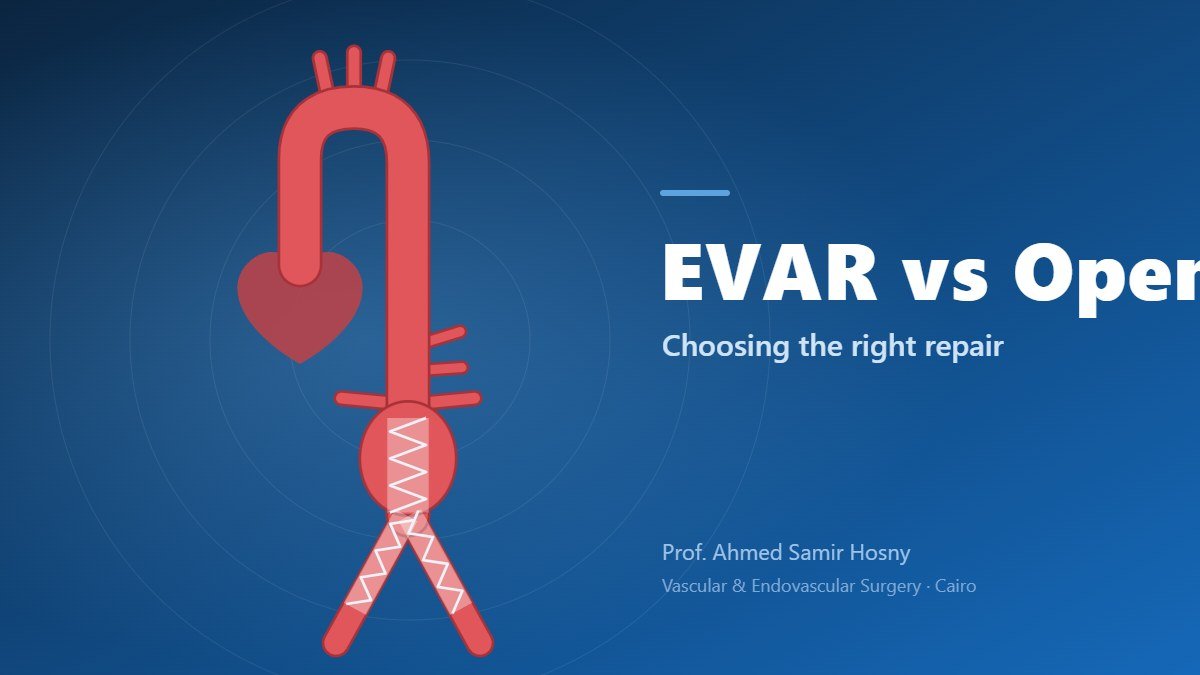
In open surgery the abdomen is opened, blood flow in the aorta is temporarily stopped, and the aneurysmal segment is replaced with a synthetic tube graft sewn into the artery. It is a long-established operation with excellent long-term results and needs less imaging follow-up once recovery is complete.
Quick comparison
- Incision: EVAR uses a needle puncture or small groin incision; open repair needs an abdominal incision.
- Hospital stay: 1–3 days after EVAR versus about a week after open repair.
- Full recovery: around two weeks after EVAR versus 6–12 weeks after open surgery.
- Early risk: lower with EVAR in the first months.
- Follow-up: EVAR needs lifelong imaging and has a somewhat higher chance of a secondary procedure in the long term.
When do we prefer EVAR?
- Older patients and those with heart or lung disease that increases the risk of major surgery.
- When the aneurysm neck and iliac arteries are anatomically suitable.
- In ruptured aneurysms when anatomy allows, because it places less stress on the body in an emergency.
When do we prefer open surgery?
- Younger, fit patients with a long life expectancy.
- Anatomy unsuitable for a stent-graft (very short or angulated neck, narrow access arteries).
- Patients unable to commit to regular imaging follow-up.
- Some cases of infection or connective tissue disease.
How is the decision made?
The decision follows a detailed CT scan of the aorta and a full assessment of heart, lung and kidney function, then an open discussion with the patient and family about the benefits and risks of each option. With modern fenestrated and branched grafts, many complex cases can now also be treated endovascularly.
Frequently asked questions
Which is better in the long run?
Long-term survival is similar with both methods, but EVAR needs continued surveillance and may require more additional procedures.
Can EVAR be converted to open surgery later?
Yes, in rare cases when the graft fails and cannot be fixed with a catheter procedure.
Is age the deciding factor?
Age matters, but it is not the only factor; overall health and arterial anatomy are equally important.
There is no single method that suits everyone — the right decision is the one designed for you.

Prof. Ahmed Samir Hosny
Professor of Vascular & Endovascular Surgery — Kasr Al Ainy, Cairo University
Professor of Vascular & Endovascular Surgery at Kasr Al Ainy, Cairo University. Fellowship in peripheral endovascular interventions (Kiel, Germany) and aortic surgery fellowship (Cologne, Germany); Member of the Royal College of Surgeons of Edinburgh.
Meet the doctor