On this page
When do we use endovascular treatment?
- Intermittent claudication that limits daily life despite medication and a walking programme.
- Rest pain or non-healing wounds caused by poor blood flow.
- When CT shows a narrowing or blockage suitable for stenting.
Kissing stents
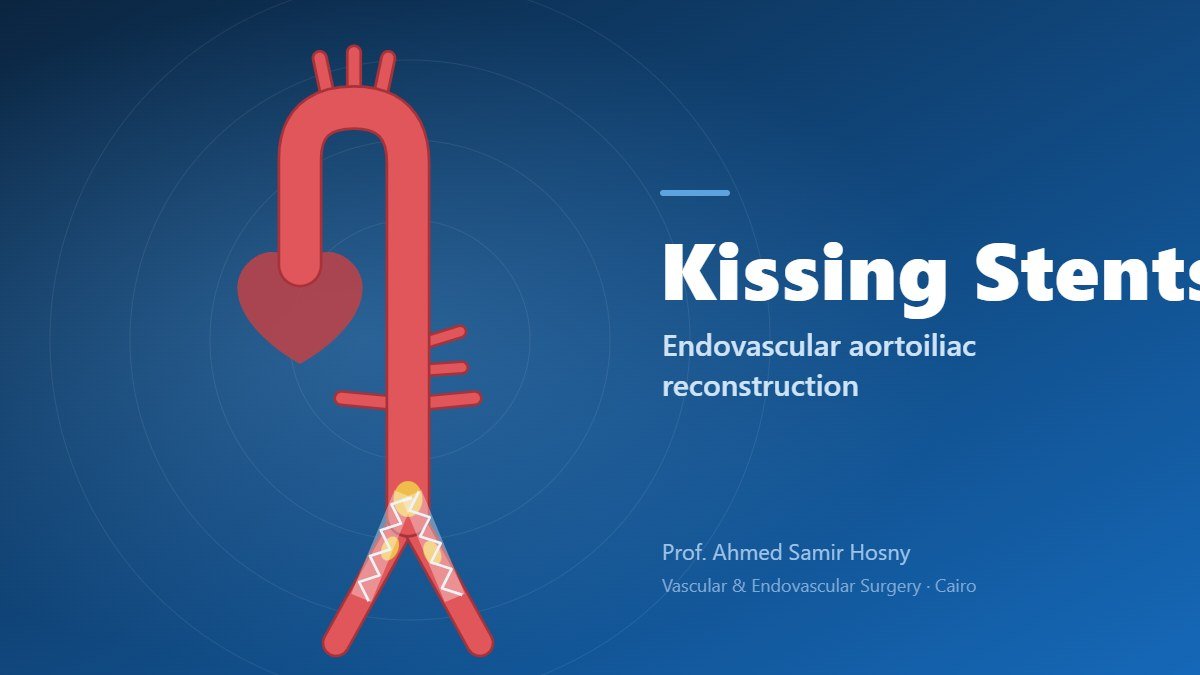
When the disease involves the aortic bifurcation, two stents are deployed simultaneously, one in each common iliac artery, meeting side by side at the end of the aorta. This opens both arteries together without pushing plaque from one side to the other.
The CERAB technique
CERAB stands for Covered Endovascular Reconstruction of the Aortic Bifurcation. A covered stent is placed in the lower aorta, then two covered stents are placed inside it into the iliac arteries, rebuilding the bifurcation in a shape that mimics normal anatomy. It is used especially for long or heavily calcified occlusions, with very encouraging long-term results.
How is the procedure done?
- Usually under local anaesthesia with sedation, or spinal anaesthesia.
- Puncture of both femoral arteries and sometimes the arm, then crossing the blockage with a fine wire.
- Balloon dilatation, stent deployment and an angiogram to confirm the result.
- Walking usually the same or next day, with discharge within one or two days.
After the procedure
Patients continue an antiplatelet and a statin, stop smoking completely and follow a regular walking programme. Follow-up with clinical examination, ABI and duplex ultrasound confirms that the stents remain open.
Frequently asked questions
How long do the stents last?
Iliac stents have some of the best results in peripheral intervention and remain open for many years in most patients, particularly after stopping smoking.
How does it compare with surgery?
Catheter treatment is less invasive with faster recovery; surgery may be better for very extensive disease or after stent failure.
Can the procedure be repeated if the stent narrows?
Yes, in-stent narrowing can usually be treated with a new catheter procedure.
A small puncture in the groin can give you back the ability to walk without pain.

Prof. Ahmed Samir Hosny
Professor of Vascular & Endovascular Surgery — Kasr Al Ainy, Cairo University
Professor of Vascular & Endovascular Surgery at Kasr Al Ainy, Cairo University. Fellowship in peripheral endovascular interventions (Kiel, Germany) and aortic surgery fellowship (Cologne, Germany); Member of the Royal College of Surgeons of Edinburgh.
Meet the doctor