On this page
Why preserve the internal iliac artery?
- Blocking it may cause buttock pain on walking (buttock claudication).
- It may affect erectile function in men.
- Rarely it causes ischaemia of the colon or spinal cord, especially if both sides are blocked.
What is an iliac branch device?
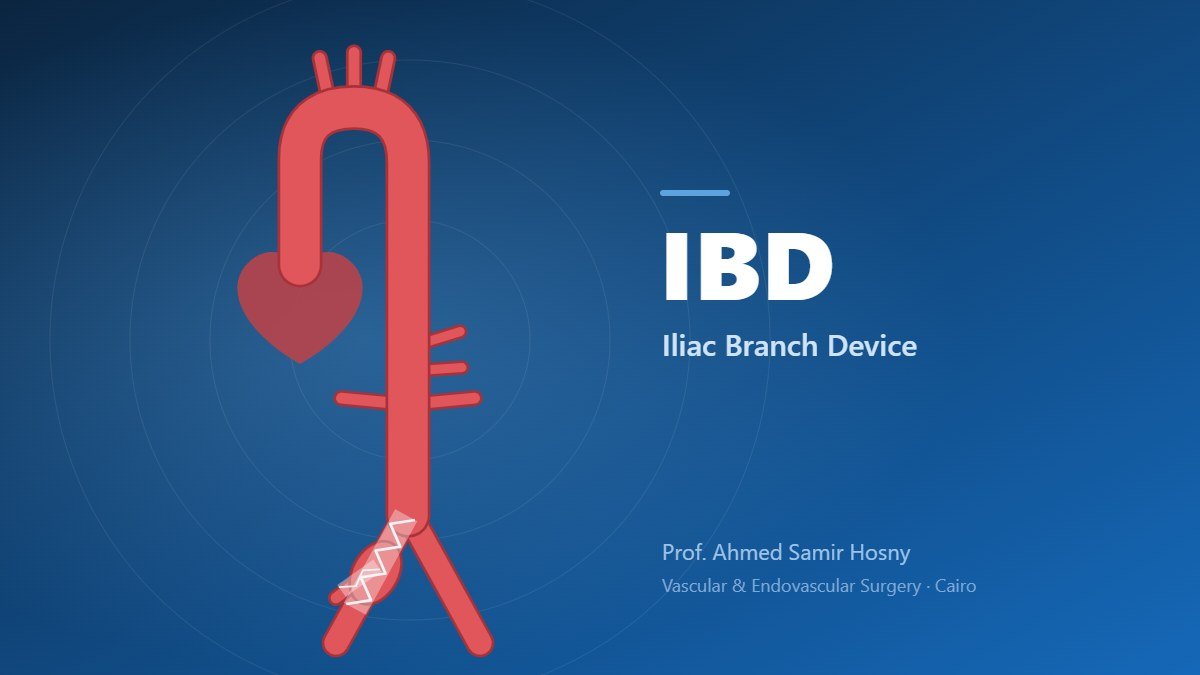
It is a covered stent-graft with a side branch directed into the internal iliac artery. After deployment the branch is connected to the internal artery with a small covered stent, so the aneurysm is fully excluded while blood continues to reach both the pelvis and the leg. It can be used alone or together with EVAR.
Who is a candidate?
- Patients with a common iliac aneurysm extending to the bifurcation.
- Patients with an abdominal aortic aneurysm plus an iliac aneurysm that prevents standard graft sealing.
- Arterial diameters and lengths on CT must be suitable.
How is it done?
It is performed through both groins, sometimes with access from the arm. The branched graft is placed in the iliac artery, its branch connected to the internal iliac artery, and completed with an aortic graft if needed. Most patients leave hospital within two to three days.
Results and follow-up
Technical success and branch patency rates are high in specialist centres, with a clear reduction in buttock claudication compared with occlusion. Regular imaging follow-up is needed, as with all aortic grafts.
Frequently asked questions
Is an iliac branch device suitable for everyone?
No. It depends on anatomical measurements; alternative techniques are used in some cases.
Can it be used on both sides?
Yes, when both internal iliac arteries need to be preserved.
Is the procedure longer than standard EVAR?
Slightly longer because of the branch connection, but recovery is similar.
The goal is not only to treat the aneurysm — but to preserve the patient’s quality of life afterwards.
Prof. Ahmed Samir Hosny
Professor of Vascular & Endovascular Surgery — Kasr Al Ainy, Cairo University
Professor of Vascular & Endovascular Surgery at Kasr Al Ainy, Cairo University. Fellowship in peripheral endovascular interventions (Kiel, Germany) and aortic surgery fellowship (Cologne, Germany); Member of the Royal College of Surgeons of Edinburgh.
Meet the doctor