On this page
What is the T-Branch device?
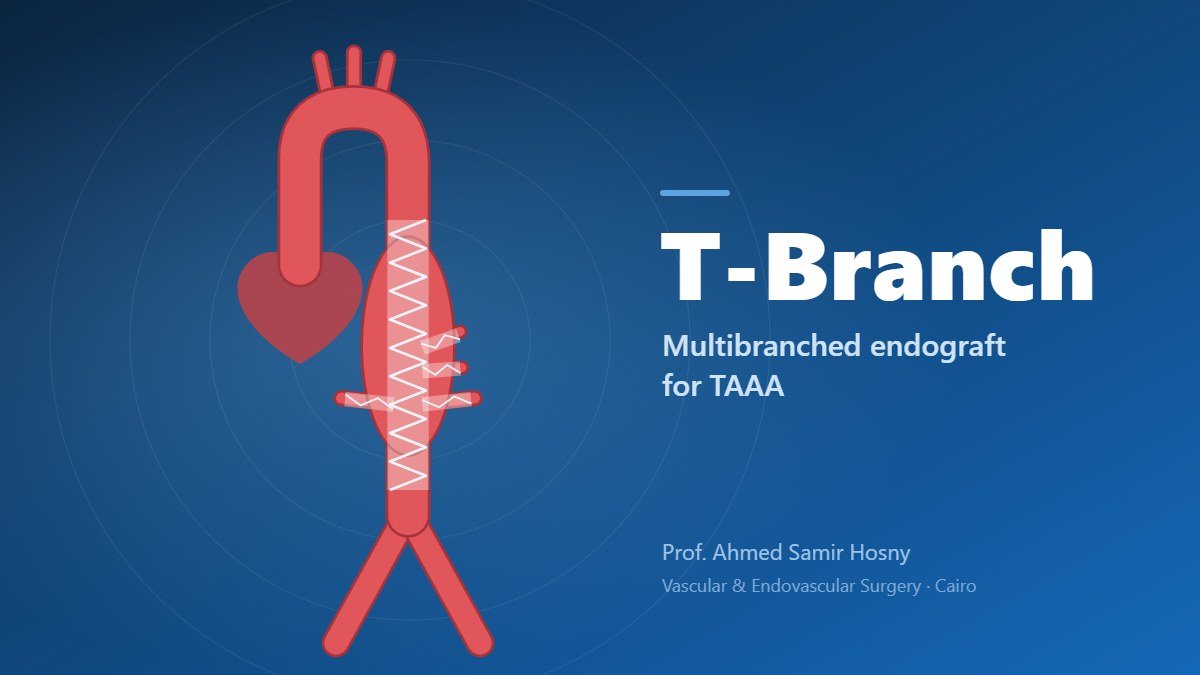
It is an “off-the-shelf” covered stent-graft with four small branches directed towards the coeliac artery, the superior mesenteric artery (SMA) and both renal arteries. After the main body is deployed in the aorta, each branch is connected to its target artery with a small covered “bridging” stent, so the aneurysm is fully excluded while every organ keeps its blood supply.
What makes it different?
- Available in standard sizes without waiting for a custom device — suitable for urgent or symptomatic cases.
- Fits a large proportion of patients because the branch design tolerates anatomical variation.
- Avoids opening the chest and abdomen and shortens hospital stay compared with open surgery.
Who is a candidate?
- Patients with a thoracoabdominal aneurysm that has reached the size for repair.
- Aneurysms close to the kidney arteries that are unsuitable for standard EVAR.
- Some aneurysms caused by chronic dissection.
- Patients at high risk from open surgery.
CT measurements must allow its use, and the arm or groin arteries must be suitable for introducing the branches.
How is the procedure done?
It is performed in a hybrid operating room with advanced imaging. The main graft is introduced from the groin, then the branches are connected through catheters from the arm or groin. The procedure may be staged to reduce the risk of spinal cord ischaemia, with spinal fluid drainage and careful blood pressure management afterwards.
Risks and follow-up
Key risks include spinal cord ischaemia, effects on kidney function, occlusion of a branch, and endoleak. Regular imaging is needed to confirm that the branches remain open and the graft stays stable.
Frequently asked questions
Is T-Branch a full replacement for open surgery?
It is an excellent alternative for many patients, especially those at high risk, but open surgery remains important for some younger patients or unsuitable anatomy.
How long does the procedure take?
Usually several hours, as it involves deploying the main graft and connecting four branches.
How does T-Branch differ from fenestrated EVAR (FEVAR)?
FEVAR is custom-made with openings matched to the patient’s anatomy and takes weeks to manufacture; T-Branch is ready-made with branches and can be used immediately.
Even the most complex aortic aneurysms now have endovascular solutions in experienced hands.

Prof. Ahmed Samir Hosny
Professor of Vascular & Endovascular Surgery — Kasr Al Ainy, Cairo University
Professor of Vascular & Endovascular Surgery at Kasr Al Ainy, Cairo University. Fellowship in peripheral endovascular interventions (Kiel, Germany) and aortic surgery fellowship (Cologne, Germany); Member of the Royal College of Surgeons of Edinburgh.
Meet the doctor